This should make you angry. You're paying for it, and will pay perhaps thousands of dollars for it.
You. Personally. And that may be if you're just lucky, since this sort of things screws up civilizations.
http://www.rollingstone.com/politics/news/bank-of-america-too-crooked-to-fail-20120314
Higher taxes. Higher prices. Fewer services. Degraded quality of life.
The bank(s) is(are) half the problem. The essential complicity of our government is the other half.
And more of the same with the so called JOBS bill (Jump-start Our Business Startups) now going through Congress. Investors will have another reason to beware, since it essentially reduces or does away with a lot of pesky disclosure formerly required of companies raising money from the public. Not that that will be a real problem, except to the suckers, er, investors, any company unwilling to disclose is looking for.
Further, there is no reason to invest in an economy that is essentially frozen by excessive rent seeking, and as Matt Taibbi documents, is increasingly run as a Kleptocracy.
And this is the real reason for the decline in IPOs. (IPO is initial public offerings, the stock companies offer when they go public.) After all, disclosure wasn't a problem before Certainly not in the 1990's, when there were hundreds each year, despite the disclosure laws they are now getting rid of.
As far as I can tell, the only difference between Democrats and Republicans is that the Democrats seem to use a little more grease.
Wednesday, March 21, 2012


Monday, March 19, 2012
On the Need for Regulation of Oligopoly and Oligopsony
A modern economy relies on a robust distribution of assets. This
distribution of assets is necessary for its distribution of income. It has a certain ‘shape,’ and the distributed
income from these assets is necessary for it to maintain that shape. Where ownership and control of these assets
is narrow, the income from these assets goes to a small portion of the economy,
depleting the rest of the economy of the income it needs to maintain itself Even where there is redistribution, there is
loss of efficiency. While this is
recognized with government redistribution, which is why large private interests
often oppose it, it also happens with private redistribution, which tends to
shortchange vital services which are not easy to extract profit from. The privately powerful also have other interests
in opposing or co-opting government authority, since government is, besides
other private interests, the only counter-weight to their own unbridled power. And this power will not always act in the public
interest. Indeed, there is no reason, once it attains a certain magnitude, to
imagine that it would act in the public interest, and instead that it would see
the public as a source of rent extraction and exploitation.
Our point is that while regulation may be a matter of
justice, it is as importantly a matter of economic stability and efficiency.
There is clearly a need for regulation in monopoly. It is in the interests
of the monopolist to produce less and charge more for what is produced, reaping
an extra normal profit. Extra normal
profit translates into extra normal growth.
This results in an increase in the share of the economy going to the
monopolist. When the monopoly is small,
this is incidental to the economy. Where
large, in proportion to the economy, however, it is insupportable in the long
term.
Just as in monopoly and monopsony, we see a need for
regulation in oligopoly and oligopsony, and their combination oligonomy. (When referring to all or any of them, we’ll
use term oligopy, and similarly oligopist.)
The point is that rational
behavior for the oligopist is not the best outcome for society. The oligopolist
will produce less, and charge higher prices, than at competitive
equilibrium. The oligopsonist will pay
less, and buy less, than at competitive equilibrium. Both will reap extra
normal profits. The continuing transfer of wealth to the oligopist leads to
accumulation and concentration of wealth and power, and a depletion of the wealth
from the rest of society, while at the same time shorting the economy of goods
and services it otherwise desires and even needs.
But this is not even in the long range interest of the
oligopist. For the oligopist, his market
must grow at a rate equal to his own.
But by collecting extra normal profits from his market, his market
cannot grow at that rate. His market grows, if at all, at a slower rate, and this rate limits the
rate at which the oligopist himself can grow.
An oligopsony reduces the revenue available to producers
facing that oligopsony. Producers cannot
sell as much, nor can they get the best prices for what they do sell. They are thus discouraged from
production. Fewer enter the market. Production is less reinvested in, becomes
undercapitalized, and tends towards obsolete methods.
When the oligopsony is in labor markets, (and the
destruction of labor union power has essentially resulted in such an
oligopsony,) it has these effects on the investment in human capital. There is greater unemployment, greater
underemployment, and less investment in education, as the labor force becomes
undercapitalized, and tends towards obsolescence.
An oligopoly, where it is a supplier of factors for other
producers, (and even finished goods may be regarded as factors for labor,) has
the same effect. Because the producer forced to buy his factors from an oligopolist
must pay more for those factors than he would if he could buy his goods in a more
competitive market. His product must either be
more expensive, sell for more and at reduced quantity, or, if priced the same, sell at reduced profit. His revenue is reduced. His ability to capitalize his business is
reduced. Production is less reinvested
in, becomes undercapitalized, and tends towards obsolete methods.
The oligopist, because of his power, finds himself in a
situation where he must sacrifice the long range good of society, and thus his
own long term interests, for the short run interests of his oligopy. Putting
it the other way, if he were to seek to better serve his society, he must put
his firm at disadvantage. The only other option is to cooperate with his fellow
oligopists in producing, or buying. to competitive equilibrium, in price and quantity. But this would entail
sacrificing their extra normal profits, and worse, losing market share in the
event any of the other oligopists defected, and ceased to cooperate. (Of course, they could always cooperate to
enhance their extra normal profits, to society’s detriment.) The preservation
of his society is simply not seen in his best interests. This is a situation he
would not be in with more perfect competition, when his interests would be more
closely aligned with that of the economy at large.
And it is a situation of composition. Where oligopy is a relatively small portion
of the economy, the economy can endure the distortions brought about by the
abnormal profits of the oligopy. The
rent collected is not so exorbitant that it cannot be compensated for, at least
to some degree, by the other operations of the economy.
It is worse when
oligopy is pervasive. Suppose the economy consists, somewhat evenly divided, of
oligopy and its market. Then the oligopist is in a quandary. What can he do with his extra normal
profits? It is pointless to invest in
the oligopy’s market, which, limited in profit from facing the oligopy, is
restricted in growth. And it is pointless to invest further in the oligopy,
which, because its market is restricted in growth, itself is restricted in
growth. Since there is no profitable
investment in the real economy, he seeks to invest in the financial economy. But the financial economy is also limited by
the real economy. Financial assets must
eventually be redeemed for real assets, but since the growth in real assets is
arrested by the extra normal profits of oligopy, there is no growth in the real
assets for any growth in the financial assets to be redeemed for. The result is a surplus of money for
investment, with no real profitable opportunity.
This is the important point.
Unregulated oligopy, with its extra normal profits, when it becomes
extensive, arrests the growth of the entire economy. Indeed, the situation is actually worse,
because by continuing to purge the rest of the economy of its normal income, it
can cause the rest of the economy’s revenue to be less than its expenses. Thus, the remainder of the economy, the
oligopist’s market, may actually be forced into contraction. But this is bad for the oligopist as well. For
an oligopolist, it will shift the demand curve left and/or down, thus reducing
the optimum quantity, or the price, or both, depending. In any case, the revenue will be reduced.
With a straight demand curve, shifting it left, down, or
left and down, are all equivalent. With
a kinked, or curved, demand curve, these each result in different diagrams, so
we have to figure what factors will reduce the price, but not the quantity
demanded, and which will reduce the quantity demanded, but not the price, and
which both. We must follow the kink, since
that is where the price and quantity will become fixed at.
If money were taken out of the market for food, say, a good with
a relatively inelastic demand, the quantity demanded would probably not change,
but the price would decline. The demand curve would shift downward, and pa would decline. In the food market it would be price
deflationary. In the more elastic market for luxury goods, the quantity demanded would probably change, but maybe not so much
the price. qa would
shift to the left, but pa
would not change so much. For goods or
services in intermediate elasticity, the demand curve would probably shift down
and to the left, and both pa and
qa
would change.
(And similarly for increases in the demand curve. The demand curve would shift up for inelastic, right for elastic, or both,
depending on the price elasticity of the good or service demanded.)
In analyzing the situation, reducing the economy to just an
oligopy and the rest of the economy, the situation then reduces to the producer-consumer
problem, with the oligopist in the position of the producer. But of course, the
oligopist attains his advantage, and his extra normal profits, not by doing
more, but by doing less, and charging more, and paying less. Rather than contributing his ‘fair
share’ for the economy, of ‘pulling his weight,’ he slacks off, and uses oligopistic power to demand more money for what he does contribute, and to pay less for what others contribute. That is, compared to the rest of the economy,
he becomes a net consumer, the consumer of the purchases of his extra normal
profits. So really, it is more
accurately described as the strong sector vs. weak sector economy, with the strong
sector extracting its rents from the weak sector. See: http://anamecon.blogspot.com/2011/11/morality-and-debt.html
We see here, with oligopy, Adam Smith's invisible hand, rather than acting to the benefit of society, acts to its detriment.
So now that we have established the need, the issue becomes
what techniques can most efficiently counter the redistributionist tendencies
of oligopy.
Thursday, March 1, 2012
Link to Michael Hudson on How Banks Plan
Another gem from Michael Hudson:
“…Everything over subsistence, they’ll want as a loan…”
“…Once the entire surplus is paid to the banks, there’s
nothing (left) over for rising living
standards, there’s nothing over for new capital investment, there’s nothing
over for long term research and development…”
Further, once growth is arrested, so is growth of the bank's
investments. It becomes a fixed income
stream on a fixed asset. Optimum is for
the banks to aim for optimum real growth rate.
But banks can’t do this.
Saturday, February 18, 2012
Oligopsonies in an Economy
Our study of oligopsonies will follow our study of
oligopolies, which the reader will find helpful to refer to. Oligopsonies are another example of the
macroeconomic effects of microeconomic processes. The derivation is based on the idea of the
kinked supply curve, which may be out there but doesn’t seem easy to find. That
oligopsonies create market distortion is well known.
We discuss competitive oligopsonies, where collusion is not
necessary.
For your convenience a little background. Oligopsonies are
ubiquitous. It seems many markets evolve into them. Although consumers do not directly experience
them, (except in labor markets,) they may often occur as the back end of
oligopolies. One oligopsony is the fast food industry, which forms an
oligopsony to meat sellers. It also
forms an oligopoly to cheeseburger buyers.
(A suggested word is oligonomy. See: http://activism101.ning.com/profiles/blogs/oligonomy-defined)
The factors, goods or services which go into the oligopolist’s product, which
are unique to an oligopoly, face oligopsony.
Other examples of (non-labor) oligopsony are 1: Cocoa
market, where three firms buy the vast majority of cocoa. 2:
American tobacco market, where three cigarette makers buy 90% of all
tobacco grown in the US
The various drug
cartels may also constitute a oligopsony
for drug producers, and an oligopoly for drug users.
The characteristics of an oligopsony are 1: It consists of a relatively few, relatively
large, buyers. 2: Each firm is big enough to affect the others.
That is, the prices each firm pays affect the prices paid by the other firms.
3: The goods or services they buy are
similar or identical. 4: There are barriers to entry, such as initial
capital costs. A firm needs to be capitalized to have a profitable use for what
it buys.
Those not interested in the derivation may jump ahead to the
discussion at the conclusion. Those
interested might also find discussions on monopsony helpful. Here’s one:
Since oligopsonies are buyers instead of sellers, instead of
a kinked demand curve, the individual oligopsonist faces a kinked supply curve,
S, which
is also his average cost curve
AC, This is the price he pays for his goods,. Diagram
1 shows this supply curve for a particular oligopsonist. The oligopsonist wants to buy at the kink, a which is at some
price pa,
which is really determined by the market, and some quantity qa,
which is determined by other factors, which we will discuss in the conclusion. In
any event, the kink at which he buys is at a lower price than the price at
competitive equilibrium, (around e)
and a smaller quantity. His total cost
is price times quantity bought, or pa
x qa.

Why does he want to buy at price pa? If he lowers the prices he offers below pa,
to pb,
hoping to save money, none of his competitors will follow. Since his prices are below theirs, and
because they are all buying the same of similar goods, sellers will go to his
competition, and he will lose market share. (Note the assumption that there is
not so much to sell, that many buyers
will have to come to him, anyway.) If the price he offers goes down a little,
the quantity of goods he is able to buy will go way down, to qb.
This is the characteristic of an elastic
supply curve. As you move down the
curve, the quantity the oligopsoninst is able to buy goes down. Since these goods are factors of production,
the oligopsonist can no longer produce at the same scale as before, cutting
into his profit margins.
Suppose instead he raises the prices he offers, from pa
to pc,
hoping to gain market share. Then his
competitors will quickly follow suit, since they don’t want to lose their market
share to him. So he won’t gain market
share, he’ll just be buying at a higher price.
He may, however, buy a few more, at qc,
just because his and everybody’s price is higher. This is
characteristic of an inelastic supply curve.
Since his costs per unit are higher, his profit margins are likely to be
slimmer, since he won’t be producing appreciably more of his product.
Now for a firm to maximize profits, its marginal costs, MC, must equal
its marginal revenue product, MRP,
which is also its demand curve, D. This is always the case, but what does this
mean? The marginal revenue product, MRP, is the use
the oligopsonist gets out of the next unit he buys. This is (mostly) a decreasing function
because of the law of diminishing returns.
This decreasing function is what we show in the diagram. (But we say
mostly because consider our restauranteur buying labor. In his case the first
worker is useless. He is simply not enough to run a restaurant. So his
MRP for
labor starts at zero and increases until
it reaches some maximum, then decreases steadily, since further workers start
getting in each other’s way and contribute an ever decreasing amount to his
total profit. Most analyses ignore this,
and you can, too. For goods, the MRP is usually a simpler, a steadily decreasing
function, although again economies of scale would make it first go up.)
Marginal cost is the increase in cost that results from buying
one more unit. For imperfect competition, as we have in the
case of oligopsonies, MC
is always more than the average cost, AC. (AC is also the supply curve, S, remember.) This is because when you buy more units, you
have to buy them at a higher price, but you have to buy all your units at that higher price. So if
the firm buys 4 units for $60 and has to pay $90 for 5 units, then the marginal
cost of the fifth unit is $30. The
average cost however, is $18, and lower than the marginal cost.
Profit is maximized when MRP
= MC because when MC
is greater than MRP,
it costs more to buy the next unit than you get use out of it. With the figures we used, you would buy 4
units for $60, get use out of them for $100, (manufacture some things you can
sell for $100, say,) and make $40 profit.
If you were maximizing profit, you wouldn’t then buy 5 units for $90,
having use of them for $125, and only make $35 profit.
See Diagram
2. The marginal revenue product MRP curve is
the downward sloping line.

With the kinked supply or AC
curve, the MC
curve is very strange. The ACL and the MCL
curve, the curves below the kink, both start at the same point on the axis, (in
the direction where the arrows come together,) but the MCL
curve ascends more steeply, twice as steep, it turns out. When they reach the
kink, however, the MCU and ACU curves, the curves above the kink, also extend
from a point on the axis, (much lower on the axis) in the direction of the
dotted arrows, so the MCU curve, being twice
as steep as the ACU curve, is much higher than the MCL curve at the kink. (The upper and lower labels
are for convenience. They are just
different parts of the same line.)
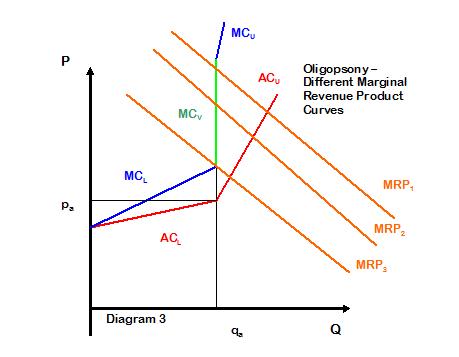
What is important is the green line, the marginal cost MCV
curve at the kink, which is vertical.
Now since, when we maximize profit, MRP
= MC, when ever MRP
crosses the green MCV
line, (at the star,) the profit maximizing quantity qa and price pa are going to stay the same. See Diagram
3. The firm, whether its marginal
revenue product curve is MRP1, or MRP2 or MRP3
is going to want to buy the same amount qa, and pay the
same price pa. This will maximize its profit.
Conclusion: Since firms in oligopsonistic competition
tend to be locked in to price, they must find other ways to compete, and
maintain or gain market share. The
leader of a drug cartel, for instance, might resort to escalating levels of
violence to secure market share. (We
make the casual observation that one need look no further than oligopsony, (and
oligopoly,) pricing to deduce a cause for Keynesian ‘price stickiness.’ In an economy rife with oligopsony we would
expect many points of price, and quantity, fixedness, making deflation a uneven
and problematic process.)
Consider MRP3 in Diagram 3. The oligopsonist would not want to
lower marginal revenue product any more, through non-price competition, because
then his profit maximization would occur at a price lower than pa,
and he would lose market share.
However, the opposite can also happen. Since price is, with in a range, independent
of costs, the oligopsonist may decide to increase his MRP,
use what he buys more efficiently, and so increase his profit that way.
Oligopsonies do not consist of identical or identically
sized firms, with identical shares of the market. The quantity a particular
oligopsonist buys at is determined by historical factors, and his ability, or
inclination, to compete in ways which do not affect the price he offers for the
goods or services he buys. Working conditions, for instance, may be one way a
labor oligopsonist may attract a better class of laborer, enhance his MRP, and so his
profits. Historical factors, for instance, most notably their activities during
the period their industry was more competitive and open, determined the
relative sizes of Wendy’s, McDonald’s and Burger King before they filled the
market and became an oligopsony. Decisions
since have changed their relative sizes and profitability.
Another point is that, unlike perfect competition, firms of
various efficiencies can co-exist in an oligopsony, operating at differing
capacities and different economies of scale, each firm collecting its
particular degree of profit. And unlike
perfect competition, much of this profit
is extra-normal. Even an inefficient
firm can make an extra-normal profit.
What other things might we expect? Well, we would expect the transfer of some producer
surplus to the buyer, in the form of his extra-normal profits. (The oligopsonistic
buyer is seldom the ultimate consumer.) Consider that oligopsonies are becoming
economically pervasive. Each of these
oligopsonies extracts its rent, transferring resources from producers, to the
oligopsonists. Indeed, to simplify
considerations, let us just model the entire economy as two tiers, consisting
of an oligopsony and those who sell to it.
Consider first perfect competition, where the economy was efficient and
in balance, Diagram
4.

Supply equals demand and the equilibrium point e, and surplus
is divided between seller and buyer. With oligopsony, Diagram 5, there is a net transfer
of surplus from the seller to the oligopsonists. (the greenish-yellow box) In the real economy, this would be manifest
as lower producer profits. We would thus
expect a gradual decapitalization of producers.
In a labor oligopsony, we would expect decrease
in the welfare of labor, as the increase in the income of the oligopsonist has
to come from somewhere.

Efficiency has also declined because an oligopsony buys less
than the competitive equilibrium production, at a lower price creating what is
called deadweight loss: The blue
triangle in Diagram
5. (I’m not sure if the blue
triangle is exactly the right one, as I am not sure the exact location of the
point of competitive equilibrium in the absence of oligopsony.) That is, the
economy is producing less than it would otherwise, perhaps less than it needs
to. In a labor market, this would imply
increased levels of unemployment. For
instance, since the public sector also supplies the private sector, as the
private sector becomes increasingly organized as oligopsony, we would expect
public sector income, supported by taxes on labor costs, to decrease. We would also expect, due to dead weight
loss, an increasing shortage of public goods.
Wednesday, February 1, 2012
Oligopoly and the Economy
This is a brief discussion of the effect of oligopolies on an
economy. It is an example of the macroeconomic effects of microeconomic processes. The
derivation is based on the idea of the kinked demand curve, developed by Paul
Sweezy in the 1950’s.
Those not interested in the derivation may jump ahead to the
discussion at the conclusion.
Those interested may find the various derivations of kinked
demand curve theory on You Tube helpful, and perhaps easier to follow than what
I have presented here. Here’s one:
http://www.youtube.com/watch?v=5BQPx8SL9F4.
You might also find discussions on monopoly, a simpler case of extra-normal profit, helpful. Here’s one:
http://www.youtube.com/watch?v=3NMbcfS68IQ&feature=related
You might also find discussions on monopoly, a simpler case of extra-normal profit, helpful. Here’s one:
http://www.youtube.com/watch?v=3NMbcfS68IQ&feature=related
And for contrast, perfect competition:
We discuss competitive oligopolies, where collusion is not
necessary for fixed prices.
For your convenience a little background. Oligopolies are a common market
structure. Indeed, many markets seem to
evolve, or have evolved, into
oligopolies, (or its cousin, oligopsonies,)
They are ubiquitous.
An oligopoly has some of the characteristics of a monopoly,
in that its members can charge higher than normal prices and make higher than
normal profits. The particular characteristics of
an oligopoly are, 1 It consists of a
relatively few, relatively large, sellers
2. Each firm is big enough to
affect the others. 3: The products are
similar or identical. 4: There are barriers to entry, such as initial
capital costs.
The traditional analysis of oligopolies is that, rather than
a normal straight demand curve, they face a kinked demand curve D, which for a particular
firm is also their average revenue curve AR. Diagram 1 shows this demand curve for
a particular oligopolist. The
oligopolist wants to sell at the kink, which is at some price pa,
which is really determined by the market, and some quantity qa, which
is determined by other factors, which we will discuss in the conclusion.In any event, the kink is at a price higher than
the equilibrium price in perfect competition, and a quantity lower than the
equilibrium quantity. Fewer goods are produced, and consumers are forced to pay a higher price for them.
If we were to discuss all the members of this oligopoly, they would each have a separate, though similar, diagram. The prices at the kink would all be the same, but the quantities at the kink might be different.
If we were to discuss all the members of this oligopoly, they would each have a separate, though similar, diagram. The prices at the kink would all be the same, but the quantities at the kink might be different.

Our oligopolist’s total revenue, that is, how much money he
takes in, is price times quantity sold, or
pa x
qa.
Why does he want to sell at price pa? If he raises his prices above pa, to
pb
hoping to make an extra profit, none of his competitors will follow. So his prices will be above theirs, and
because their products are similar to or identical to his, he will lose some,
perhaps many of his customers to them.
If his price goes up a little, the quantity of products he sells will go
way down, to qb
so he will take in less money. The area
pb
x qb, the money he takes in now, is less than the area pa x qa,
the money he took in before. This is the
characteristic of an elastic demand curve. As you move up the curve, the
quantity sold goes down faster than the price goes up.
Suppose instead he lowers his prices, below pa,
to pc, hoping to gain market share. Then his competitors will quickly follow suit,
since they don’t want to lose their market share to him. So he won’t gain market share, he’ll just be
selling at a lower price, and making less money. He may sell a few more products, at qc just
because his, and everybody’s, price is lower, but not enough to compensate for
the decrease in price. The area
pc
x qc , the money he takes in now, is less than the area pa x qa,
the money he took in before. This is the
characteristic of an inelastic demand curve.
As you go down the demand curve, the price goes down faster than the
quantity sold goes up.
Now for a firm to maximize profits, its marginal costs, MC, must equal
its marginal revenue MR. This is always the case, but what does this
mean? Marginal cost is the increase in
total cost accrued by the firm for the next unit it produces. If the firm produces 4 units for $60 and 5
units for $90, then the marginal cost of the fifth unit is $30.
Marginal revenue is the increase in revenue that results
from selling one more unit. For
imperfect competition, as we have in the case of oligopolies, MR is always
less than the average revenue, AR. This is because when you sell more units, you
have to sell them at a lower price, but you have to sell all your units at that lower price.
So if you sell 4 units at $100 total revenue and 5 units at $120 total
revenue the average revenue AR,
the price you are selling them at, for 5 units is $24, but the marginal revenue
MR for
the 5th unit is only $20.
Profit is maximized when MR
= MC because when MC
is greater than MR,
it costs more to produce the next unit than you get paid for it. With the figures we used, you would produce 4
units for $60, sell them for $100, and make $40 profit. If you were maximizing profit, you wouldn’t
make 5 units for $90, having to sell them at $120, and only make $30 profit.
See Diagram
2. The marginal cost MC curve is the
lopsided “u.”
When you produce something, costs first go down, savings of scale, then they go
up, dissavings of scale. (Imagine a
restaurant. The first meal is very
costly, because of all your fixed costs. As you produce more, each next meal is
cheaper to produce, as you use your assets more efficiently, until you reach
some minimum. Then the costs per each
additional meal start going back up, because you run out of stove space, people
start getting in each others way, etc.)

With the kinked demand or AR
curve, the MR
curve is very strange. The upper ARU and the upper MRU curve, the curves
above the kink, both start at the same
point on the axis, (in the direction where the arrows come together,) but the MRU curve descends more steeply, twice as steep, it
turns out. When they reach the kink, however, the MRL
and ARL curves, the curves
below the kink, also extend from a point on the axis, (much higher on the axis)
in the direction of the dotted arrows, so the MRL curve, being twice
as steep as the ARL curve, is much lower than the MRU curve at the kink. In this
diagram, in fact, it is so much lower it is negative, which means MRL curve is irrelevant. What is not irrelevant is the fact that,
because MRL is negative, the MR curve which
connects the MRU and MRL curves, (green line) crosses the Q axis at the kink. This means that the quantity of production of
maximum revenue (which is where the MR
curve crosses the Q
axis) and profit maximization (where MR
= MC)are at the same quantity, qa.
What is important is the green line, the MR curve at the
kink. Now since, when we maximize
profit, MR
= MC, when ever MC
crosses the green line, the profit maximizing quantity and price are
going to stay the same. See Diagram 3. The firm, whether its marginal cost curve is MC1, or MC2 or MC3 is going
to want to produce the same amount, and charge the same price. Here this will maximize both profit and
revenue.

Conclusion:
Even in competition, oligopolists can make extra-normal profits. Firms in oligopolistic competition tend to be locked in to price, so they must find other ways to compete, and maintain or gain market share. (We make the casual observation that one need look no further than oligopoly pricing (and as we shall see, oligopsony pricing) to deduce a cause for Keynesian ‘price stickiness.’ In an economy rife with oligopoly we would expect many points of price, and quantity, fixedness, making deflation a uneven and problematic process.) The owner of a service station, for instance, locked in competition with 3 other service stations at an intersection, might, to attract more customers, initiate full service, or add a convenience store or coffee shop. He might do this, raising his costs, until the marginal cost curve was something like MC3 in Diagram 3. The oligopolist would not want to raise costs any more, because then his profit maximization would occur at a price higher than pa, and he would lose market share.
However, the opposite can also happen. Since price is, with in a range, independent
of costs, the oligopolist may decide to shave costs, cut corners, and so
increase his profit that way. Were an
industry to do this, we would have a situation like the American auto industry
in the 60’s and 70’s, before imports began to significantly impact on their
market.
Oligopolies do not consist of identical or identically sized
firms, with identical shares of the market. The quantity a particular oligopolist
sells at is determined by historical factors, and his ability, or inclination,
to compete in ways which do not affect the price. Historical factors, for instance, most
notably their activities during the period their industry was more competitive
and open, determined the relative sizes of GM, Ford, Chrysler, and American
Motors, back when they constituted an oligopoly. Foreign Competition and decisions since have
changed their relative sizes and profitability.
Another point is that, unlike perfect competition, firms of
various efficiencies can co-exist in an oligopoly, operating at differing
capacities and different economies of scale, each firm collecting its
particular degree of profit. And unlike
perfect competition, much of this profit is extra-normal, more than the profits
we would expect to see from perfect competition, which tends to drive profit to
a minimum.
What other things might we expect? Well, we would expect the transfer of some
consumer surplus to the producer, in the form of his extra-normal profits. Consider that oligopolies are becoming
economically pervasive. Each of these oligopolies
extracts its rent, transferring resources from consumers, to the oligopolists. Indeed, to simplify considerations, let us
just model the entire economy as two tiers, consisting of an oligopoly and its
market. Consider first perfect
competition, where the economy was efficient and in balance, Diagram 4.

Supply equals demand and the equilibrium point is at e, and surplus
is divided between consumer and producer. (Consumer’s Surplus is
exaggerated a bit, to keep the lines the same. Sorry.)
With oligopoly, Diagram
5, there is a net transfer of surplus from the consumer to the
oligopolists. (the greenish-yellow box)

In the real economy, this would be manifest as higher corporate profits, and, since most corporate stock is held by the wealthy, an increase in income of the wealthy. Corresponding to this, we would expect a decrease in the welfare of the rest of the economy, as the increase in income of the wealthy has to come from somewhere.
Efficiency has also declined because an oligopoly produces
less than the competitive equilibrium production, at a higher price creating
deadweight loss: The blue triangle. That is, the economy is producing less than it
would otherwise, less than consumers would be willing to buy at the lower,
equilibrium, price. Indeed, the economy
may perhaps be producing less than it needs to.
For instance, since the public sector is also supplied by the private
sector, as the private sector becomes increasingly organized as oligopoly, we
would expect public sector costs to increase disproportionately. We would also expect, due to dead weight loss,
an increasing shortage, and/or a decline of the quality, of public goods. This includes much of the infrastructure the
private sector, the oligopolist, relies on.
Wednesday, January 11, 2012
Link to Michael Hudson- Democracy and Debt
Nice read here:
http://michael-hudson.com/2011/12/democracy-and-debt/
All about the financial sector’s inability to restrain their economically destructive tendencies throughout history, and the social ruin attendant on their ascendancy.
We get to see it again. They get to see it again. And they still can’t restrain themselves.
http://michael-hudson.com/2011/12/democracy-and-debt/
All about the financial sector’s inability to restrain their economically destructive tendencies throughout history, and the social ruin attendant on their ascendancy.
We get to see it again. They get to see it again. And they still can’t restrain themselves.
Saturday, December 31, 2011
On the Economics of Evil
Elsewhere, http://www.truthabouttheone.com/2010.07.01_arch.html we have talked about how evil arises in the mind, and a little of how it is made manifest in the world.
One may wonder how one talks about evil in an economics blog. It is almost impolite. After all, evil is, in the end, irrational, and ignorance part of its nature. And economics is the domain of the all knowing, rational agent. One might say, economics is the study of the behavior of God, or gods, at least, anyway, under some of its more implicit assumptions. Perhaps this is one of the profession’s problems, then, when trying to explain the behavior of men.
Evil is as evil does. So what is as evil does? What is the economics of evil?
Evil sacrifices the greater good for its immediate gain. Since its own welfare is ultimately dependent upon the greater good, it thus consumes the foundation of its own wealth, and must look ever farther to feed its hungers, until it can no longer support itself, and collapses. But before it collapses, it may have consumed the substance of many. Those incapable, those inattentive, or those ineffectual in opposing it.
Eventually, good always triumphs. Good may triumph through might. But the reason, though, good always triumphs is because in the end, evil always fails. But it may succeed for a time, and the damage it may have inflicted be awful.
And when the good turns evil, it fails. Signs of turning evil are signs of failure. But not all signs of failure are signs of an internal evil. Failure may be imposed from above, inflicted.
It first seems as if we can talk about evil in terms of what are called discount rates. An individual with the lower discount rate is a person who ‘values the future more.’ He is a person more prepared to reduce consumption today so that he has more to consume tomorrow, and is held as somehow more virtuous, ‘more good,’ than someone who consumes more today, with perhaps less thought of tomorrow.
But we are living through a period where this virtue turns into exploitation, and destructive of the foundations of all wealth. An individual with a lower discount rate, exchanging with a person with a higher discount rate, will eventually come to possess all the other has, no matter how small the difference in discount rate. Even if the person with the larger discount rate is a person of relative virtue, he is not virtuous enough to retain his wealth. Is the gradual confiscation of the wealth of the less virtuous, then, itself a sign of virtue, or a sign of a lack of restraint, and of evil?
Or is instead the failure of the person with the higher discount rate a sign of his ‘evilness?’ For failure is what will result. He will lose his capital. Should he now be condemned to labor as a slave on behalf of the person with the lower discount rate, who now may consume the fruits of the labor of both, in perpetuity? Who is evil? The slave, who has become so because of his inadequate virtue, or the slaver?
The slaver, having consumed the wealth of his slave, is reduced to consuming the slave’s surplus, which it is in the slave’s interest to minimize. Having reduced the slave to subsistence, the slaver must then compel him to produce more.
So we see that commission of a lesser evil, what can be just a tiny difference in discount rates, by one, becomes, if not countered, the making of a greater evil, by the other.
Where is the happy median?
The accumulation of capital by a society is a great virtue. But so is its proper allocation. And this proper allocation is necessary, for when the wealth of a society becomes excessively concentrated, it can no longer maintain itself without the consumption of the capital of the rest of that society. Virtue pursued to excess has become Evil.
It justifies itself by its earlier successes still, yet its ends have changed. No longer is virtue seen as the pursuit of the common good. For the common man has proven himself to be without virtue, and dross, unworthy of the considerations of the powerful. What was Virtue turns to the fulfilling of its own now insatiable needs, and, at first just incidentally, the impoverishment of others. It goes too far, first blighting the lives and hopes of those less endowed, or less lucky, and then becoming corrupt and turning on itself, feeding on itself.
Evil is seldom pure. How do we recognize when virtue has turned evil, and harnessed to evil ends? How do we recognize the deterioration of our society, our nation, and our world? How do we recognize the infliction of evil, and the imposition of failure?
After all, Evil will cloak itself in virtue. Its agents may even, at first, imagine themselves virtuous. And what it imposes will not be called failure. It will be called something else. Evil deceives, doing one thing while saying it does another. And where it does what it says, its motives and goals are not what it says they are. But because Evil’s ends are irrational, as these become clear, irrational too become its justifications. Its speaking, and its actions, become increasingly detached from reality, and from each other. And its speaking and its actions become increasingly incoherent
Evil inflicts misery, whether or not it profits. And its profit is always less than the misery it inflicts. Evil provides no nourishment. What it seems to provide is never worth the price.
Evil does not create, except implements of destruction. It only manipulates, and takes. Indeed, creation is anathema to Evil, which opposes creation at every turn. It destroys what it cannot have, and pollutes, both what it does not possess, and what it does.
Evil cannot control its appetite. No amount of wealth is sufficient to its needs. And what to others are wants, mere desires, to Evil are needs, and needs that can never be satisfied.
Evil’s end is not what power can do, to the benefit of others, but power itself, and what it can do to gratify its needs. Evil considers itself to be justified in its extravagance.
_________________
We coddle the wealthy. We are told that they are the creators of jobs. Yet, there were more jobs when they were not so coddled. There was more wealth, and more creation of wealth, when the wealthy did not have so much. And now, we are told, we must give them even more. We, the people, must tighten our belts, and sacrifice of our own wealth, to feed the needs of the wealthy, the wealthy creditors who hold our debt, the debt of the people.
But ask the wealthy. Are they not virtuous? Do they not deserve the rents they extract from the people? Have the people, the debtors, through their inferior virtue, not embonded themselves to their creditors, the wealthy?
We will always have the wealthy. They will always extract their rents and fees from the people. But when are they too much? When are they more of a burden, than any benefits which the people might gain from them? Or are the rents and fees extracted from the people put to good use? Who, or what do they feed? If the wealthy would be the masters of the people, are they good to the people, or are they not? Are the extractions returned to the people, as the virtuous master would do? (But why should they be? Are not the people of inferior virtue to the wealthy, and undeserving?) Or are they not instead turned on self consumption, and the feeding of the worms of competing corruption which are now at the economic processes at the heart of the nation, and perhaps the world?
With the growth of the global economy, the reach of Evil is the ends of the earth, and, unless effectively opposed and contained, it will consume the sustenance of all else before it consumes itself.
But- perhaps we should look at the latest corruption in high places as- justice. Tolerating Evil, even perhaps, as some claim, inflicting it on others, Evil comes to us.
There are those who believe that, or say that, having achieved wealth and prominence, that this is evidence of moral superiority; that they are morally superior to those of us who have not. (Have we ourselves not said this? Have we not used our nation’s wealth and power to justify our- ‘Exceptionalism?’) Do the wealthy use this to justify their stewardship, or their extravagance? Is it become an instrument to do good, or wealth to conspicuously consume, resources denied to others, and wantonly destroyed. Do they nourish others, or deprive them of things they value, of the resources needed for the enjoyment of such liberty as they have?
The moral justification of those in high places can be rephrased: They rule for the benefit of the people, to shower them with the blessings of their making. Or, instead, they rule to inflict punishments on the people, who by their inferior virtue, come to deserve them.
The powerful cannot be merely indifferent. Then they are only self-serving, and there is no basis to their claims on wealth, and no reason for society to grant them.
Are the poor and undeserving supposed to accept these hardships, laid upon them by the demands of the wealthy, as justice served?
And what do we see, but the enforcement of this process, the reduction of debtor to slave, by our government. Are we surprised then, by reaction against the government, since it has become an instrument of compulsion, for the extraction of rent from the people, to the vast enrichment of a few. The protector of the people, having become enslaved by the wealthy, is despised by the people. Do the people, rather than seeking their government’s freedom, despair of their government, and turn on it, and seek its destruction?
Do those who tolerate evil deserve evil things to happen to them? Is it a form of justice that those who tolerate evil, though they do no evil themselves, should be punished? Is tolerating evil itself evil? Is being a bystander to a crime itself a crime? Is to allow evil to consent to evil?
Justification for government and regulation is seen by the behavior of the wealthy. Without a strong and free government, the wealthy cannot do other than they do, and that is to wreak great harm on the society that supports them, and their wealth. And we, the members of that society, may react one of two ways: We may accept the punishment, allow the destruction of our society and our wealth, and consider it just reward for our failures, or we may oppose the evil.
Finally, though man is limited in knowledge and rationality, the shape of the future is becoming increasingly clear. The earth is limited. The ends of the earth have been found, and been found to be not so very far. Consideration of and action to counter overpopulation, global warming, the depletion of resources and increasing toxicity of the environment, are all becoming more imperative. Will man pursue the course of evil, with evil consequences, or will he seek the course of rationality, and act accordingly?
One may wonder how one talks about evil in an economics blog. It is almost impolite. After all, evil is, in the end, irrational, and ignorance part of its nature. And economics is the domain of the all knowing, rational agent. One might say, economics is the study of the behavior of God, or gods, at least, anyway, under some of its more implicit assumptions. Perhaps this is one of the profession’s problems, then, when trying to explain the behavior of men.
Evil is as evil does. So what is as evil does? What is the economics of evil?
Evil sacrifices the greater good for its immediate gain. Since its own welfare is ultimately dependent upon the greater good, it thus consumes the foundation of its own wealth, and must look ever farther to feed its hungers, until it can no longer support itself, and collapses. But before it collapses, it may have consumed the substance of many. Those incapable, those inattentive, or those ineffectual in opposing it.
Eventually, good always triumphs. Good may triumph through might. But the reason, though, good always triumphs is because in the end, evil always fails. But it may succeed for a time, and the damage it may have inflicted be awful.
And when the good turns evil, it fails. Signs of turning evil are signs of failure. But not all signs of failure are signs of an internal evil. Failure may be imposed from above, inflicted.
It first seems as if we can talk about evil in terms of what are called discount rates. An individual with the lower discount rate is a person who ‘values the future more.’ He is a person more prepared to reduce consumption today so that he has more to consume tomorrow, and is held as somehow more virtuous, ‘more good,’ than someone who consumes more today, with perhaps less thought of tomorrow.
But we are living through a period where this virtue turns into exploitation, and destructive of the foundations of all wealth. An individual with a lower discount rate, exchanging with a person with a higher discount rate, will eventually come to possess all the other has, no matter how small the difference in discount rate. Even if the person with the larger discount rate is a person of relative virtue, he is not virtuous enough to retain his wealth. Is the gradual confiscation of the wealth of the less virtuous, then, itself a sign of virtue, or a sign of a lack of restraint, and of evil?
Or is instead the failure of the person with the higher discount rate a sign of his ‘evilness?’ For failure is what will result. He will lose his capital. Should he now be condemned to labor as a slave on behalf of the person with the lower discount rate, who now may consume the fruits of the labor of both, in perpetuity? Who is evil? The slave, who has become so because of his inadequate virtue, or the slaver?
The slaver, having consumed the wealth of his slave, is reduced to consuming the slave’s surplus, which it is in the slave’s interest to minimize. Having reduced the slave to subsistence, the slaver must then compel him to produce more.
So we see that commission of a lesser evil, what can be just a tiny difference in discount rates, by one, becomes, if not countered, the making of a greater evil, by the other.
Where is the happy median?
The accumulation of capital by a society is a great virtue. But so is its proper allocation. And this proper allocation is necessary, for when the wealth of a society becomes excessively concentrated, it can no longer maintain itself without the consumption of the capital of the rest of that society. Virtue pursued to excess has become Evil.
It justifies itself by its earlier successes still, yet its ends have changed. No longer is virtue seen as the pursuit of the common good. For the common man has proven himself to be without virtue, and dross, unworthy of the considerations of the powerful. What was Virtue turns to the fulfilling of its own now insatiable needs, and, at first just incidentally, the impoverishment of others. It goes too far, first blighting the lives and hopes of those less endowed, or less lucky, and then becoming corrupt and turning on itself, feeding on itself.
Evil is seldom pure. How do we recognize when virtue has turned evil, and harnessed to evil ends? How do we recognize the deterioration of our society, our nation, and our world? How do we recognize the infliction of evil, and the imposition of failure?
After all, Evil will cloak itself in virtue. Its agents may even, at first, imagine themselves virtuous. And what it imposes will not be called failure. It will be called something else. Evil deceives, doing one thing while saying it does another. And where it does what it says, its motives and goals are not what it says they are. But because Evil’s ends are irrational, as these become clear, irrational too become its justifications. Its speaking, and its actions, become increasingly detached from reality, and from each other. And its speaking and its actions become increasingly incoherent
Evil inflicts misery, whether or not it profits. And its profit is always less than the misery it inflicts. Evil provides no nourishment. What it seems to provide is never worth the price.
Evil does not create, except implements of destruction. It only manipulates, and takes. Indeed, creation is anathema to Evil, which opposes creation at every turn. It destroys what it cannot have, and pollutes, both what it does not possess, and what it does.
Evil cannot control its appetite. No amount of wealth is sufficient to its needs. And what to others are wants, mere desires, to Evil are needs, and needs that can never be satisfied.
Evil’s end is not what power can do, to the benefit of others, but power itself, and what it can do to gratify its needs. Evil considers itself to be justified in its extravagance.
_________________
We coddle the wealthy. We are told that they are the creators of jobs. Yet, there were more jobs when they were not so coddled. There was more wealth, and more creation of wealth, when the wealthy did not have so much. And now, we are told, we must give them even more. We, the people, must tighten our belts, and sacrifice of our own wealth, to feed the needs of the wealthy, the wealthy creditors who hold our debt, the debt of the people.
But ask the wealthy. Are they not virtuous? Do they not deserve the rents they extract from the people? Have the people, the debtors, through their inferior virtue, not embonded themselves to their creditors, the wealthy?
We will always have the wealthy. They will always extract their rents and fees from the people. But when are they too much? When are they more of a burden, than any benefits which the people might gain from them? Or are the rents and fees extracted from the people put to good use? Who, or what do they feed? If the wealthy would be the masters of the people, are they good to the people, or are they not? Are the extractions returned to the people, as the virtuous master would do? (But why should they be? Are not the people of inferior virtue to the wealthy, and undeserving?) Or are they not instead turned on self consumption, and the feeding of the worms of competing corruption which are now at the economic processes at the heart of the nation, and perhaps the world?
With the growth of the global economy, the reach of Evil is the ends of the earth, and, unless effectively opposed and contained, it will consume the sustenance of all else before it consumes itself.
But- perhaps we should look at the latest corruption in high places as- justice. Tolerating Evil, even perhaps, as some claim, inflicting it on others, Evil comes to us.
There are those who believe that, or say that, having achieved wealth and prominence, that this is evidence of moral superiority; that they are morally superior to those of us who have not. (Have we ourselves not said this? Have we not used our nation’s wealth and power to justify our- ‘Exceptionalism?’) Do the wealthy use this to justify their stewardship, or their extravagance? Is it become an instrument to do good, or wealth to conspicuously consume, resources denied to others, and wantonly destroyed. Do they nourish others, or deprive them of things they value, of the resources needed for the enjoyment of such liberty as they have?
The moral justification of those in high places can be rephrased: They rule for the benefit of the people, to shower them with the blessings of their making. Or, instead, they rule to inflict punishments on the people, who by their inferior virtue, come to deserve them.
The powerful cannot be merely indifferent. Then they are only self-serving, and there is no basis to their claims on wealth, and no reason for society to grant them.
Are the poor and undeserving supposed to accept these hardships, laid upon them by the demands of the wealthy, as justice served?
And what do we see, but the enforcement of this process, the reduction of debtor to slave, by our government. Are we surprised then, by reaction against the government, since it has become an instrument of compulsion, for the extraction of rent from the people, to the vast enrichment of a few. The protector of the people, having become enslaved by the wealthy, is despised by the people. Do the people, rather than seeking their government’s freedom, despair of their government, and turn on it, and seek its destruction?
Do those who tolerate evil deserve evil things to happen to them? Is it a form of justice that those who tolerate evil, though they do no evil themselves, should be punished? Is tolerating evil itself evil? Is being a bystander to a crime itself a crime? Is to allow evil to consent to evil?
Justification for government and regulation is seen by the behavior of the wealthy. Without a strong and free government, the wealthy cannot do other than they do, and that is to wreak great harm on the society that supports them, and their wealth. And we, the members of that society, may react one of two ways: We may accept the punishment, allow the destruction of our society and our wealth, and consider it just reward for our failures, or we may oppose the evil.
Finally, though man is limited in knowledge and rationality, the shape of the future is becoming increasingly clear. The earth is limited. The ends of the earth have been found, and been found to be not so very far. Consideration of and action to counter overpopulation, global warming, the depletion of resources and increasing toxicity of the environment, are all becoming more imperative. Will man pursue the course of evil, with evil consequences, or will he seek the course of rationality, and act accordingly?
Subscribe to:
Posts (Atom)