Saturday, July 28, 2012

The Party of the Rich has Triumphed in its Spead of Disinformation


The party of the rich has triumphed in its spread of disinformation. Check out this poll by Bob Livingston,  “Poll Results: Higher Taxes for the Rich or More Drastic Spending Cuts,” at personalliberty.com:

Of course, Bob is somewhat to the Right of Center, as are his readers and the responders to his poll. See Q5.  But, among his responders: 60% think that higher taxes on the rich will hurt the economy, and only 23% voted to increase taxes on the  richest Americans.  76% voted the government should make significant spending cuts to try to reduce the deficit. 

As for where those budget cuts should come from, 0% voted for cuts in Social Security, Medicare or Medicaid, (except for the 18% who voted ‘All of the above.’)  22% voted for cuts to Foreign aid, which is an insignificant portion of the budget.  A bit of disinformation there.  27%, (the largest,) voted  for the elimination of Federal Agencies (the EPA, Dept of Education, etc.  You know, things to do with our future, and Justice, the Treasury, including the IRS, etc., things to do with running the day to day stuff.)  Only 7% voted for cuts in the Dept of  Defense, despite its legendary wastefulness. 

For a more realistic perspective on what can and cannot be done, check out the NY Times ‘Budget Puzzle’, from Nov 13, 2010: http://www.nytimes.com/interactive/2010/11/13/weekinreview/deficits-graphic.html


But the real bottom line, of course, is the coddling of the rich. Getting 60% thinking that increasing taxes on the rich will hurt the economy, against all historical evidence, including the evidence of their own experience.   Taxes on the rich haven’t been lower in most of these readers’ lifetimes, and when during those lifetimes has the economy ever been in such sorry shape? This is surely one of history’s great triumphs of propaganda.  Getting a sizeable percentage of the population to think against their own interests, to identify with those who exploit them, and to imagine their interests align with those who, over the past 30 years or so, have taken over 15% of their income, (http://anamecon.blogspot.com/2010/10/what-income-of-top-1-means-to-rest-of.html ) and a greater percent of their wealth, is astounding.

It is also a triumph over logic:  What the rich do not pay in taxes, the rest of the people will have to. What the rich do not pay for defense, or for the common wealth of the people that is the government, the rest of the people will have to. Further, who does the government borrow from?   The rich.  So the rich are giving their money to the government anyhow, but when it is borrowed, they expect it paid back, eventually.  With interest.  And where does that money come from?  The people. 

And who’s services will get cut?  Not the rich’s.  The people’s.  When Education, Health and Human Services, Energy, all get cut, who will be the poorer?  Not the rich.  You can bet the rich will have the money to grease the palms of Congressmen to keep their places at the public trough warm and well stocked. 

And who will be at the front lines when the payrolls of government are slashed?  The Wall Street banker?  Or the Main Street small businessman, who depends on government wage earners, and other government expenditures, directly or indirectly, for a part of his business. 


Friday, July 13, 2012

One of the Main Functions of Government is to Consume Excess Production


One of the main functions of government is to consume excess production, hopefully in a socially constructive manner, and so maintain the price level. Keynes suggested this, as a solution to inadequacies of demand, but it must be done even in 'good' times, and adjusted, for bad. That is, government consumption must be increased during recession or depression.  Further, the government must redistribute even more as industries become more capital intensive.  To do this in perpetuity, government’s debt cannot get out of hand, but must be constrained as a percentage of GDP.  This means collect more taxes, and these must necessarily be collected from the rich.

First, the wealthy consume less as a percentage of their income than the rest of the population. They save more. On the other hand, since the government will spend all it collects in taxes, collecting more in taxes from the rich will be economically stimulatory.   That is, the economic multiplier on taxes on the wealthy is greater than one.    This implies a strongly progressive tax to stimulate the economy. 

Indeed, from the point of view of economic stimulus, there is no point in taking taxes from the poor, or even much of the working class, when their savings is very low.  Any money taken as taxes from the poor would have been spent anyway, and so would not provide net stimulus to the economy.  What is more, a certain rate of savings in the middle and lower classes should generally be seen as desirable, since it would act as an automatic stabilizer.  Money would be saved during good times, helping to slow down the economy, and dis-saved, or spent, during recession or depression, helping to stimulate the economy, thus helping to smooth economic fluctuations.      

Further, as the owners of capital, an increased share of market income will go to the wealthy as industries become more capital intensive.  More demand, that is money, will have to be redistributed to maintain the market, which otherwise would slowly contract as labor is increasingly forced out of the productive process. (The same thing happens in a country as production is off-shored. No country can afford to have a significant proportion of the goods it consumes to be imported, unless it has compensating exports.  Thus the need for balanced trade.  See:  http://anamecon.blogspot.com/2010/04/effects-of-unbalanced-trade.html)  Indeed, given the observation that one of the government’s functions is to consume excess production, and running a trade deficit effectively increases that excess,  much of a government’s deficit can be laid at the feet of that trade deficit.)

Now there is no market for labor forced out of the productive process. This is because, as unemployed, they do not represent a market for production.  Supply increases, due to increased capital expenditures, but ultimate demand does not, because there is no increase in the number of consumers, that is, labor. Demand increasingly becomes concentrated at the top. (Of course, the wealthy could spend this money on providing public goods and services to the rest of their community. They instead rail against government, and do not themselves provide the things the community needs.)   

On the contrary, the absence of a progressive tax is/will be depressive, and destabilizing, as wealth becomes more concentrated and inequality increases. One of the causes of this destabilization is that as wealth becomes more concentrated, the market for commodities and financial instruments becomes thinner, and subject to greater fluctuations, as fewer people have the greater concentrations of wealth to invest in the various markets. Meanwhile, the market for production, represented by the middle and working classes, gradually contracts in the absence of a progressive tax.  The government, for a time, may maintain this by running up debt.  But this is regarded by many as unsustainable.

Privatizing government functions is counterproductive, since profits in privatized industries cause an increase in the upward redistribution of income, which must be counteracted with an even greater progressivity of taxes to compensate.  Indeed, a certain amount of inefficiency in government spending is a virtue, as it allows wider dispersion of government expenditures. 

What is important is the efficiency with which government collects taxes from the wealthy, since the primary goal is the constant redistribution of demand throughout the economy.  If it is inefficient in collecting taxes from the wealthy, too much money will remain at the top, and it will be inefficient at redistributing this money to the base of the economic pyramid, where it is needed to stimulate demand.  In particular, the taxes on the wealthy should be increased during recessions and depressions, that is periods of inadequate demand and excess supply.  Of course, that suggests taxes on the wealthy be decreased during periods of inflation, when they are large, but they are now already inadequate.  We are talking about a tax rate centered about 65% or so, and adjusted from there, depending on circumstance:  Higher during bad economic times; lower during good economic times. 

Tuesday, June 26, 2012

Regulating Oligopoly and Oligopsony


Regulating Oligopoly and Oligopsony

Having concluded there was a need to regulate oligopoly and oligopsony, ( http://anamecon.blogspot.com/2012/03/on-need-for-regulation-of-oligopoly-and.html ) we discuss some ways how it might be done. Other suggestions are welcome.

The problem is the oligopolist produces less than the competitive equilibrium, and at a higher price, while the oligopsonist buys less than the competitive equilibrium, and at a lower price.
 
In dealing with oligopy we wish to decide which oligopies are most damaging.  Those in elastic markets, for instance, would be naturally limited in their ability to extract rents, while those in inelastic markets would have greater opportunity, and given the situation, inclination, to do so.  Similarly, the costs of entry to a market would also set limits on how much extra normal profit could be collected. Low entry costs would limit the extra normal profits to low levels, since higher profits would encourage the entry of other firms into the market.

With damaging oligopy, one way is simply to tax the results. A problem here is getting the receipts back to the damaged parties.  Another problem with this solution is that it would not affect the oligopist’s equilibrium, to produce at higher prices and lower quantity produced than at competitive equilibrium for oligopoly, and to buy at lower prices paid for and a lower quantity than at competitive equilibrium for oligopsony. That is, it would not eliminate bottlenecks in an economy. As may be, this approach would be to tax extra normal profits at a punitive rate, say, 90% of profits over 6% (allowing for a 3% inflation rate.)  The point is, by the time oligopy is manifest, the market is relatively fixed in proportion to the economy as a whole. Yet because of the price scheme of the oligopy, the market is defective in size to the economy, and the rent collected goes into the bank, ie taken out of the economy at large, or goes into buying up assets in the economy at large, increasing the proportion of ownership of the oligop, at the expense of the other members of the economy.  So one would wish to force the oligopy to grow to proportion of and at the growth rate of the economy as a whole.  (This is a mature market problem, not a growing market one.  It is not a problem of a company expanding into an open market, such as Apple, with its product innovations.  Extra normal profits here can still be a problem to an economy, and lead to alterations in the distribution of wealth and power.  But the reinvestment of extra normal profits in plant is also necessary to expand production to meet the demand a smaller company cannot reasonably fulfill.) 

What is desired is that normal profits are allowed to be reinvested in the oligopy, while extra normal profits are returned to the economy at large.  In oligopoly, one might gear the tax to be scaled at 6% on profit per unit produced, (with a 3% nominal rate of inflation, and a 3% rate of growth.). This would be effectively a progressive VAT, or value added tax, on the ologopoly.  This would incentivize the oligopolist to produce to competitive equilibrium, since the maximum profit would then be proportional to quantity produced. (Actually this by itself wouldn’t quite work, as the oligopolist would just be encouraged to internalize costs, so as to reduce his ‘profit’ to the 6%.)   

Another is to institute price floors in the case of oligopsony, or price ceilings in the case of oligopoly, at what one would hope to be nearer the equilibrium price for a perfectly competitive market. One example of price floors, with oligopsonies, is with minimum wage laws.

A problem here seems to be that one loses the use of price signals, although this is actually not a problem with oligopy, since the quantity traded is no longer responsive to prices anyhow.  Or more correctly, the price becomes fixed, and unresponsive over a large variation of economic conditions. In any case, over a large variation, price and quantity do not respond to the demands of the economy. While these price levels could just be legislated, probably a more efficient method would be a competitive buyer, in the case of oligopsony, or a competitive producer, in the case of oligopoly.  In the case of oligopoly, another option might be to subsidize production.  This option, subsidizing production, would fail, however, in all cases but the mildest kinks, that is, where there were numerous competitors in the oligopoly, (or hardly like an oligopoly at all.)  This is because, with a severe kink, the vertical part of the Marginal Cost MC curve extends through the price axis, or at least very close, and thus all or most of the cost of production would have to be subsidized in order to encourage an increase in quantity produced.  Otherwise, the quantity for profit maximization would not change. This would still be useful, in cases like health care, where the goal was universal coverage.  See: http://anamecon.blogspot.com/2010/03/real-problem-with-health-care-in-us.html

Similarly, just buying up large quantities from the oligopoly would be very expensive, since you would be buying at the oligopolist’s price, and providing him his extra normal profit, as is in fact the current US government policy with respect to the health care industry.  Policy should be to force the oligopolist to sell at a price nearer the equilibrium price.  Again, the situation with health care is different, since if you want universal coverage, you want to drive the oligopolist’s price to near zero, and to do so must effectively subsidize the entire production.  That is, make health care a public good. 

In the case of oligopsony, by competitive, we mean a buyer who buys sufficient goods to drive the price up to what it would be under competitive equilibrium.  This buyer would constitute a regulator.  And what would the signals be, that this regulator would look for?  He would seek a normal profit for suppliers. (This assumes that for firms facing the oligopsony, there is no barrier to entry.  If there were such a barrier, we would expect the situation to evolve into one of oligopoly facing oligopsony. Does such a market exist at a competitive equilibrium?  It would seem to depend on the relative elasticities of the supply and demand.)

One way this might be shown would be an equilibrium in firms entering and leaving the market.  This shows how the quantity of suppliers might also be regulated. By increasing the price and quantity bought, firms would be encouraged to enter the market.  By reducing the price and quantity bought, firms would be encouraged to exit the market.

The idea of government being a last resort buyer of labor suggests an alternative to minimum wage laws.  The government would enter the labor market and act as a monopsonist, and bid up wages until the unemployment rate was down to desired levels.  Private industries would have to pay this rate also, or lose employees to the government.

The situation would seem to be more difficult with oligopoly.  The problem with the government producing to competitive equilibrium is that governments are notorious for producing inferior products.  Another problem, as in agriculture and education, is what the government actually does.  That is the government subsidizes production into the face of oligopsonies.   This results in producing a surplus of goods into a buyers market, driving down the prices.  (Indeed, the prices have been driven down so low, in the case of education, that buyers, the institutions of higher education, must be paid to accept most of the production of public education. The prices are negative.  This is an alternative way of looking at the distribution of pricings and cost burdens in education.  On the other end, businesses refuse to pay the universities for the production of the universities, their graduates.  They do not send clear signals as to what they want, except in a few career specific employment and unemployment rates. 

One way to rein in oligopoly is to promote the production of substitute goods.  The development and subsidy of alternative energy sources, for instance, would moderate the action of oil and coal oligopolists, which is one of the reasons they oppose alternative energy sources so fiercely.
   
As another alternative, the government could employ the aggressive use of anti-trust legislation, to prevent the formation of oligopoly. Probably a figure of providing 20% of the market would constitute a member of an oligopoly.  Thus, keeping firms below that size would prevent the kink from becoming too pronounced.  A problem arises, when the oligopoly faces oligopsony, or monopsony, as in retail supermarket chains, with their limited shelf space.   By hindering one, one encourages the other, and oligopsony can be as socially destructive as oligopoly.   

Another possible solution is to separate the functions of the oligopy, making one part into a quasi-utility, and eliminating costs of entry to the other function.  Thus, for instance, (as was done with British rail) providers of cable TVcould be separated into parts, one which merely operated and maintained the cable, and the other which provided the content, paying the operators of the cable a fee.  The operator would be a regulated monopoly, and the content providers would be competitive, the costs of entry, one of the prerequisites for oligopoly, minimized.  The same could be done with cell phones, the towers being regulated, and selling their bandwidth, which they would seek to maximize, for a fee.

Health care in the US is an instance of oligopoly. Actually it is an instance of several different oligopolies.  One is medical equipment supply.  Another is pharmaceutical supply.  Locally hospitals form oligopolies.  (Hospitals are an obvious choice for regulated utility.)  Finally, a limited supply of doctors and other medical personnel creates an effective oligopoly to health care consumers.   Production of health care is restricted, driving up prices. Buying from the oligopoly will not change this, and indeed can be expected to further drive up prices. 

For industries requiring a high level of maintenance of resources, such as farming, further regulation might be required of producers, to prevent depletion of assets in efforts to temporarily acquire extra normal profits.  Progressive taxation would be helpful here, since it increases the present value of future returns, rather than exploitation of the resource for immediate returns.

Wednesday, June 13, 2012

Milton Friedman: "The Social Responsibility of Business is to Increase its Profits," is Wrong


Milton Friedman, "The Social Responsibility of Business is to Increase its Profits," is wrong.

In his famous article, “The Social Responsibility of Business is to Increase its Profits,” (originally published in the New York Times Magazine September 13, 1970, see eg:http://www.colorado.edu/studentgroups/libertarians/issues/friedman-soc-resp-business.html) Milton Friedman quotes himself from his book Capitalism and Freedom:

"there is one and only one social responsibility of business–to use it(s) resources and engage in activities designed to increase its profits so long as it stays within the rules of the game, which is to say, engages in open and free competition without deception or fraud.”

This is his concluding line in an article dedicated to denigrating the idea of “social responsibility” in businesses, and in particular by corporate executives. For a corporate executive to act in a “socially responsible” manner, Dr. Friedman posits that “it must mean that he (the corporate executive) is to act in some way that is not in the interest of his employers.”  That is, any act, (not geared to maximizing profits,) in excess of the minimum required by law and custom is not in the interests of his employers. 

His conclusion is at least naïve.  Clearly, a business can increase its profits if  “it stays within the rules of the game, which is to say, engages in open and free competition without deception or fraud."  How much easier, though, to maximize its profit by externalizing all costs, by capturing and corrupting government, and altering the rules of the game to its convenience?  How much easier to profit by eliminating free and open competition, and legalizing deception and fraud? 

Dr. Friedman criticizes the 'socially responsible' postures taken by executives in and prior to 1970.  He further condemns socially responsible behavior by smearing it with the ‘socialist’ paint brush:   ”This is the basic reason why the doctrine of "social responsibility" involves the acceptance of the socialist view that political mechanisms, not market mechanisms, are the appropriate way to determine the allocation of scarce re­sources to alternative uses.”  Here Dr. Friedman makes no compromise. He essentially claims that market mechanisms are the only way to determine the allocation of scarce resources, denying any limitation to or failure of markets, or any use for political mechanisms of allocation.  But pollution control, and work place safety, are political allocations of resources, and ones which would be opposed by market mechanisms.  The failure of the market in the US to provide universal health care is another case in point, assuming universal healthcare is desired by a majority of the people.  


Milton Friedman's claim that the sole social responsibility of business is to increase its profits, places businesses into an adversarial relation to society.  That is, businesses become the enemies, the exploiters, of the society of which they are a part.  The logical conclusion of Dr. Friedman’s statement is that it is not a part of the social responsibility of business to behave in a socially responsible manner.  His implication, although I don’t think he realized this, is indeed quite the opposite, that a business should behave in a socially irresponsible, and even socially destructive, manner, if this increases its profit. This position is schizophrenic.  It is as if the hand was encouraged to act against the interests of the body of which it was a part.


There are ways of increasing a business’ profits which are damaging to the society of which it is a part. Indeed, it is a tendency of business to seek to externalize all costs. Thus, to pollute, to ignore worker safety regulations, to engage in mis-representation if not fraud, etc. If the business is in competition, and these things are permitted, it must do them, since its competitors, similarly situated, will also do these things.  Its competitors, if allowed to externalize costs by polluting, will do so, and so it must also.  Its competitors, if allowed to externalize costs by skimping on worker safety, will do so, and so it must do so also.  Further, business will seek subsidies by the government, and taxes by the government on its competition.

The conclusion of Dr. Friedman’s position implies the necessity that the corporate executive act without conscience.  This is necessary, since any operation of conscience within the confines of the executive’s office would be contrary to the profit maximization principle under which the executive, as an employee of the owners, is obliged to operate.  Indeed, profit maximization obligates the corporate executive to pollute and otherwise externalize all costs, so far as practically permitted, and to undertake the corruption of the regulating bodies, that is the corruption of government. 

But where is the root of his error?  Consider this quote from the article: “Society is a collection of individuals and of the various groups they voluntarily form.”  Society is hardly a mere collection.  It is dynamic, and its dynamic is non-linear. Society is not merely the collection of individuals, or even the mere collection of their actions.   The effect of everybody doing a thing, is quite different from the effect of just one or a few persons doing that thing.  Society is more than the sum of its parts. A business is more than the sum of its parts.  And the actions of businesses, and the other parts of society, combine in non-linear, and synergistic ways. There are returns of scale, and greater returns on the scale of integration of an entire society.  A business unconcerned with these interactions does society, and itself, disservice.  Dr. Friedman’s conception serves to atomize and divide, and reduce those social returns to scale, impoverishing society.  This is what we have seen, in the triumph of his error, and the rise of those who subscribe to it.


Consider instead a purely operational, and self-interested, definition of conscience: seeking to do that which is ultimately best for one’s self:  Seeking the larger good, with the expectation that one’s own welfare will be improved if that larger good is enhanced.  We do assume that the executive is interested indeed in maximizing the profits of his company. Then a goal of the business executive is the optimization of his society, (and by optimizing we can here mean purely maximizing the economy's growth rate,) since in an optimum society, his corporation itself is optimized, and in the long run, its profits maximized.  Thus, the executive with conscience will seek to participate in, and encourage the development of, a well regulated market, one which will enhance the value of his business to society, since in such a market growth is optimized for all businesses.  Therefore, rather than corrupting the regulators, he will seek regulation which maximizes the efficiency of resource allocation. Rather than competing in a race to the bottom, he will seek effective regulation that will encourage all businesses to good behavior. The business man of conscience, therefore, will speak out against corruption, and the capture of government by other businesses. As this will be in his own long term best interest.

The corporate executive’s duty to his employers is not uncritical obedience to the principle of short term profit maximization. Long term maximization requires the long term survivability of the society of which it is a part. 

Neither do the owners enjoy all incidents of property.  Ownership of property in any society is not an absolute.  It entails duties.  Society, and its government, retain the most important incidents of property, and this implies the obligation of the owners to ”socially responsible” behavior.   All individuals in society, by voluntary agreement, undertake this. 

While it is beneficial for each business to pursue its narrow interests, even to act in an unethical manner, (which Dr. Friedman in the larger sense implies is OK as long as it is within ‘the ‘rules of the game,’) it is bad for each business if all businesses act so.  Where all businesses sacrifice the larger good, sacrifice their ‘responsibility to society,’ for their narrower interests, all are poorer, and all lose. Where all businesses sacrifice the larger good, the larger good contracts.   

Even the winners lose. Therefore, it is in the interests of each business, to see that other businesses act in an ethical manner.  Thus, that the business exists in a well regulated market, and not a corrupt, environment.


We take Dr. Friedman to his logical conclusion, and that business indeed exists in an adversarial relationship to society, that its ultimate interests are contrary to the interests of society.  Then there is no intrinsic restriction to its activities in that society:  There is no limit on the things it can, or should, do, to gain profit. So business should seek to capture government,  and seek to ‘free’ itself from the constraints of regulation, and mitigate or corrupt that regulation.  Then when business captures government, and corrupts regulation, it must be that the government also acts contrary to the interests of society.  Therefore, it is in the interests of society, that the separation of business and state remain inviolate.  The Supreme Court’s decision Citizens United, therefore, must be considered inimical to society, at the least a terrible mistake, and those who support it, and profit by it, society’s enemies.

Clearly, it is in the interests of failing executives, and failing businesses, to corrupt government, and to legitimize deception and fraud.  Failing at production, they seek success through corruption.  Instead it is in the interests of successful executives and businesses to seek a well-regulated environment, and good government.

Society is captured by men who do not believe that the larger good is to their benefit, and therefore seek their own narrower self-interests, to the destruction of the larger good, and ultimately their own.

That our government is captured by executives and businesses, many of which would otherwise fail, that is to say, are not producers in any real economic sense, and so could not compete in a free and open market, bodes ill.   

Executives and corporations have taken Dr. Friedman's statement to heart.  His prescriptions have, so far as they have been carried out, done untold damage to the economy.

Thursday, May 31, 2012

Progressive Taxation Encourages Investment


Progressive taxation can be an important tool in conserving natural resources, since it increases the relative present value of future returns, by reducing the returns to immediate exploitation of the resource.  Consider an example:  A capital good, a wood lot, say, provides an income stream of $100,000 in perpetuity.  Now, if the tax is flat, and the resource can be cashed out, for $2,000,000, and invested at interest for 5%, then the owner would be indifferent to exploiting or conserving the resource.  On the other hand suppose, with a progressive tax, the $100,000 was taxed at a miniscule rate, and the $2,000,000 at 50%.  Then the owner would have to be able to invest the $1,000,000 that remained after taxes at a 10% rate in order to be indifferent to preserving or exploiting the resource.  If this rate were unavailable, he would be more interested in conserving, rather than exploiting, this resource.

Indeed, progressive taxation increases the relative present value of any future income stream, and so encourages investment in the future.

Tuesday, May 8, 2012

The Extraction of Money from Communities in the New Economy


     The sound you don’t hear is the sound of money being sucked out of your community.  But you can see it.   Walmart is merely the biggest.  Target, Home Depot and Lowes.  Best Buy.  Staples.  McDonald’s and Wendy’s, Burger King.  The old standards like  Penny’s and  Sears. Even  PetCo,  Starbucks and ToysRUs. CVS and Walgreen’s.  The grocery chains.  Shell and Mobil and Sunoco.  And then of course  the big banks, Bank of America ,Wells Fargo, the rest.  They are pervasive.    Everywhere. 

      And what are they?  They are all extractive industries. 

      And that is what they extract?  Money.  Money from your community.

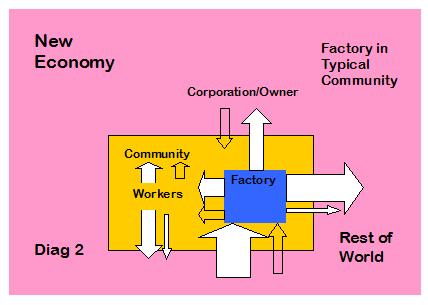
      And this is a new thing, this reorganization of the American economy.  It used to be, in the days of mom and pop stores, of locally owned factories and family farming, of small banking, that more of the money remained in the community, helping to maintain the flow of resources within and through the local economy. Factories and farms brought in the money.  Returns of production costs of the product went to the community.  Merely the cost of the materials which it used in manufacturing went outside the community, and this it recouped through the price of selling. The community also retained the profit, when the owner of the factory was local. See Diag 1, the factory in the Old Economy. (The sizes of the arrows within each diagram are merely indicative.  The important thing is the difference in sizes of the arrows between the diagrams.  Remember also the flow of money is opposite to the flow of goods and services.  When goods go out of the factory, and are sold in the Rest of the World, money flows in.)  The factory is a part of the community.  The factory brings money into the community by selling its product to the Rest of the World outside the community.  The only money it exports is for the material and energy which goes into making that product.  The rest of the money goes either to the workers, or to the owner.
      The workers, and the owner, who was a part of the community, spend some of their money in the Rest of the World, but spend most of their money in the community.  It is thus more likely that the amount of money retained by the community is greater than the money which leaves the community.  So the community prospers and grows.   
(Note, however, it grows by extracting money from other communities.  With a constant money supply, this is a zero sum game.   One community’s gain is another community’s loss.  Indeed, for a community to grow without deflation, it must have an influx of money.   And it is difficult for a community to grow with deflation, because under deflation, on average, businesses are nominally losing money.)

      The ‘Old Economy’ is no longer.  Now the profit goes to the headquarters of the giant corporations.  And to their owners, who take the money extracted from your community and spend it in theirs.   This makes their communities prosperous, while yours declines. See Diag 2, the factory in the New Economy.  The diagram is really no more complicated. All the flows of money are in the same directions. The extra solid arrows indicate increases in money being spent.  The clear arrows indicate money which is no longer being spent.  Thus in Diag 2.  the extra arrow going from the factory to the Rest of the World is the increase in costs due to the fact that the factory must buy its factors from oligopolies, while the clear arrow indicates money lost due to increased competition and the fact that it must sell to oligopsonies in the Rest of the World.  The money going to the owner does not necessarily change, but now, since the corporate owner is no longer in the community, the profits from the factory also leave the community.  Facing oligopsony, the Factory’s return is minimized, reducing profits and forcing the reduction of overhead.  This means replacing workers with machines.  So the capital costs leave the community, and the lost jobs reduce income to the community.  The clear arrow from the Factory to the workers in the community represents the reduction in income to the community due to decreased payrolls, a result of increases in productivity and mechanization.  Since the workers, as well as the factory, are now buying from oligopolies, more money leaves the community through them, and the clear arrow to the community indicates that less is retained by the community.  Thus the direction of the flows are the same, but the quantities are different, with more of the money from the operation of the factory leaving the community, and less staying in the community.  
      
      While it is possible for this community to also be prosperous, it is more likely, than in the old economy, that it is not, but rather that more money is being taken out of the community than is coming in.  It is still possible for the factory to be operating at a profit, that is the money coming into the factory is greater than the money going into the rest of the world and the workers. The owner is then making a profit.  However, it is more likely, than in the old economy, that the money going to the workers is also less than that leaving the community.  Thus, the community would be in decline.

      We can make a similar comparison of diagrams between old and new economies by studying the flow of money through their respective stores.  In the old economy, the store is locally owned, in the new, corporately owned. 

      Consider Diag 3, the store in the Old Economy.  The store is locally owned.    Money comes into the community from outside, say through a factory.  It could be farm production, or just the returns from the labor of members of the community in other communities.  Some is spent at the store, some circulates through the community, some leaves the community through other channels.  Of the money spent in the store, some goes to the Rest of the World, that money the store spends on products there.  But much, even most, is retained by the community, as wages, as profit to the local owner, as money paid to local producers.  Of the profits paid to the owner, some are spent in the Rest of the World, some spent in the community.  In any case, a relatively high percentage of the money spent in the store remains in the community. 

      Compare this to Diag 4, the store in the New Economy, in a ‘typical’ modern community.   This is the chain store, owned by a distant corporate owner. (Some of these are franchises, locally owned, but all sending a cut to the distant corporation.)  Again, the diagram is really no more complicated than the first one, the store in the old economy.     The flows of money are all in the same direction.   The added solid arrows indicate an increase in the flow of money, the clear arrows a decrease.  Money comes into the community from outside, through what the community produces.   This may be farm production, the production of a factory, or the labor of members of the community in other communities.  This is reduced from before (clear arrow from Rest of World to Community,) because the Community faces oligopsonies.  With a chain store, there is an increase in flow into the Rest of the World.  First, of course, the profits of the store go to the corporate owner, and leave the community.   This is also indicated by the clear arrow from the Corporation to the Community.   Second, there is little or nothing bought from local producers, so that arrow now points into the Rest of the World. Finally, there is the increase in money due to the fact that the goods the store buys are now bought from oligopolies, and thus at a higher cost. 

      
       This last needs to be discussed, because it is not so clear cut. While the chain store faces oligopolies, it is often an element of an oligopsony, and thus can command lower prices for the goods it buys.  Further, there is the natural savings due to trade.  (But this tends to drive out the local producers.) What is certain that it can, with its volume purchases, command prices from its suppliers lower than a locally owned store, and thus put the locally owned store at a competitive disadvantage.  This reduction is indicated by the clear arrow from the community to the store.  Indeed, because of this, the chain, so far as it presents substitutable goods, tends to drive the locally owned store out of business, and replace it.

      But to continue, the chain store, where it is larger than its competitors, can reduce labor costs two ways.  First, through more efficient labor practices, that is selling a greater volume of goods per unit of labor, and second through oligopsony in the labor market, driving down the costs of labor to a minimum.  It tends to drive wages down to the minimum, actually.    This is indicated by the clear arrow from the store to the workers.   Since the workers also face oligopoly in the rest of the world, the flow of money from the workers to the Rest of the World increases.  Together these factors reduce the amount of money the workers circulate in the community.  This needs to be discussed.

      The cost of labor to the store is really a zero sum for the community.  The greater the labor costs, the more the community must pay.  The less the labor costs, the less the community must pay. But in either case, the money comes back to the community as wages paid to the workers.   So it is really only a factor in the chain store competing against local businesses, lower labor costs allowing lower pricing and thus greater competition against the local business.  This forces down the price of labor in the local businesses, so long as they remain competitive.  It does change the distribution of money in the local community, reducing the share available to low wage earners, but this is another matter. 

      Aside from the differences due to oligopoly and oligopsony, the two major differences are the profits  leaving the community to the corporate owners,  and the money that leaves the community instead of going to local producers.  As in the new factory economy, the bottom line is the increase in money flowing out of the community, and the decrease in money flowing into the community, making it more likely, than in the old economy, that the community may be losing money rather than gaining it, and so be in decline.  If we realize that a prosperous community is only a few percentage points to the good, that is, the community typically makes only a small ‘profit,’ this is a significant difference, and may mean the difference between success and failure.

      And a successful community may be an extractive community, that is, one that relies on the extraction of resources from other communities.  We have indicated how successful factory communities extract money from other communities.  But we look now at Diag 5, the Store in Owner Communities.  

      The arrows have been simplified and reduced, but otherwise it is the same as Diag 4, except the corporate owner is a part of this community, and is responsible for a great influx of money into the community.  Indeed, the owner may be the major, or even the only source of money to the community. (By owner here, corporate owner, we don’t necessarily mean just the owner per se.  For instance, in a community with a corporate headquarters located in it, all the staff of the headquarters would be included under the term ‘owner.’  Even a corporate engineering office would qualify, (although that could also be analyzed as a factory, as could the headquarters itself.)  Not that they are necessarily actually owners, but rather that their employment is dependent on the flow of money from distant stores and factories.)   

      In any case, the inflow the sum of profits extracted from many communities, is more likely greater than the outflow.  For oligops living in communities distant from the ones they exploit, the fate of these other communities is secondary to their profits. 
      
      And what are the symptoms of excessive extraction? 

      Well, you can tell the poor communities, because few of the extractors mine there.  The money is gone. The ore has been played out.   Oh, perhaps the inferior extractors, like Dollar Tree, or Family Dollar, or the Payday Loan check stops, still plough the poor soil.  But the better ones, even many of the not so good ones, have left.   Those that require the rich ore, the high end extractors, the Bergdorf’s, the Saks, the fashion boutiques, the Abercrombie & Fitchs, the Aeropostales,  who require higher margins from their smaller volume;  the Apple stores, have long gone, if they ever came.        
   
      A community  may benefit from trade, where it is a net producer of goods, but this is increasingly difficult.    Free trade exposes a community to oligopsony and oligopoly.  Oligopsony minimizes the benefits the community receives from its own production, whether it be factory, or farming, or mining.   Oligopoly maximizes the extractions from the community, of goods sold in the community.   So a community may suffer from trade, even when it remains a producer.  It will likely benefit, where it is an extractor/owner community, but theses are comparatively few.  A community either benefits from the advantages of trade, or instead suffers extraction, of which a deficit in the public budget, is one aspect.  As money is sucked out of the community, unemployment rises, and locally owned businesses decline.    The tax base erodes. The schools decline, and maintenance of roads and infrastructure deteriorates.     The public commonweal is destroyed.

      Corporations are not interested in the typical communities of America, except as a source for the extraction of money.  Indeed, according to Milton Friedman, their only social responsibility is to increase their profits.  That is, their interest is in the destruction of the community.  Look at Apple.  They send their jobs to China and their profits to Lichtenstein.  They do not love AmericaAmerica to them  exists only to be exploited.   Their store is here.  They are interested in investing in stores here, but not so much in factories.  This is because in a community which is still a source of extraction, which still has money, everything costs more.  And this means the cost of labor, and thus the cost of production, is higher. 

      That is why corporations are not investing in America, except in extractive industries.  They are not investing in producing in America, because it means investing in the communities of America, and they have yet to be depleted by the extractive actions of these same corporations.  The costs are high, because of oligopoly, and the returns are low, because of oligopsony, oligopoly and oligopsony these corporations themselves inflict.  

      As for the extractors, they cannot spend their money fast enough.  And, because they cannot spend it fast enough, they put it in banks, often overseas.   From there, it makes its way back to the front banks in the US, where it is loaned to members of your community, and the interest is extracted.  Or they invest it in other extractive industries, other retail chains, or factories overseas.  The products of these factories are used to extract money from the communities in which they are sold. And the money from the production of these products, no longer made by factories in the community, is extracted by these overseas factories.   And the cost of shipping from overseas is also extracted.

      We come to an interesting conclusion.  As long as there is money to be extracted, extractors will come, with their stores, and seek to extract that money from the community.  (But worse is Amazon, which you do not see.   Amazon spends nothing in your community.  The entire monetary value of the imported product is extracted from the community.  Because those brick and mortar stores you do see spend most of their overhead in their respective communities, at least the community retains that, and the damage is less.  But Amazon and the rest of the mail order companies spend nothing, and are engaged in pure extraction.)

       And the members of the community become a party to the destruction of their community, and their own destruction.  Because the extractors do not bear the cost of supporting the community, they can sell at lower prices.  And the members of the community, in perceived self interest, benefit from these lower prices.   But their community does not, because the money saved is merely spent at other stores, and still exported from the community.  Not enough money is retained by the community to maintain the money supply in the community, and that supply declines, along with the community welfare. It could be said that the community consumes itself to death, as increasingly each act of consumption, in the New Economy, costs the community money.  

Tuesday, April 3, 2012

Links to NPR: Money in US Politics


Here's a link to an NPR episode on money in US politics.  You probably don't know how bad it really is:


Here's the teaser.  Just 10 minutes:


 Should make you want to listen to the main episode.

This American Life is doing a series, which we will try and keep you up on.