The sound you don’t hear is the sound of money being sucked
out of your community. But you can see
it. Walmart is merely the biggest. Target, Home Depot and Lowes. Best Buy.
Staples. McDonald’s and Wendy’s, Burger
King. The old standards like Penny’s and
Sears. Even PetCo, Starbucks and ToysRUs. CVS and
Walgreen’s. The grocery chains. Shell and Mobil and Sunoco. And then of course the big banks, Bank of America ,Wells Fargo, the
rest. They are pervasive. Everywhere.
And what are they? They
are all extractive industries.
And that is what they extract? Money.
Money from your community.
And this is a new thing, this reorganization of the American
economy. It used to be, in the days of
mom and pop stores, of locally owned factories and family farming, of small
banking, that more of the money remained in the community, helping to maintain
the flow of resources within and through the local economy. Factories and farms
brought in the money. Returns of
production costs of the product went to the community. Merely the cost of the materials which it
used in manufacturing went outside the community, and this it recouped through the
price of selling. The community also retained the profit, when the owner of the
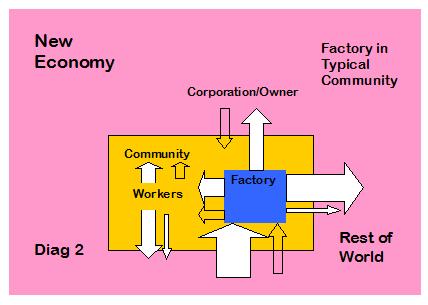
factory was local. See Diag 1, the factory in the Old Economy. (The
sizes of the arrows within each diagram are merely indicative. The important thing is the difference in
sizes of the arrows between the
diagrams. Remember also the flow of
money is opposite to the flow of goods and services. When goods go out of the factory, and are
sold in the Rest of the World, money flows in.)
The factory is a part of the community.
The factory brings money into the community by selling its product to
the Rest of the World outside the community.
The only money it exports is for the material and energy which goes into
making that product. The rest of the
money goes either to the workers, or to the owner.

The workers, and the owner, who was a part of
the community, spend some of their money in the Rest of the World, but spend
most of their money in the community. It
is thus more likely that the amount of money retained by the community is
greater than the money which leaves the community. So the community prospers and grows.
(Note, however, it grows by extracting money from other
communities. With a constant money
supply, this is a zero sum game. One
community’s gain is another community’s loss.
Indeed, for a community to grow without deflation, it must have an
influx of money. And it is difficult
for a community to grow with deflation, because under deflation, on average,
businesses are nominally losing money.)

The ‘Old Economy’ is no longer. Now the profit goes to the headquarters of
the giant corporations. And to
their owners, who take the money
extracted from your community and spend it in theirs. This makes their communities prosperous,
while yours declines. See
Diag 2, the
factory in the
New Economy. The diagram is really no more complicated. All
the flows of money are in the same directions. The extra solid arrows indicate
increases in money being spent. The
clear arrows indicate money which is no longer being spent. Thus in
Diag
2. the extra arrow going from the
factory to the Rest of the World is the increase in costs due to the fact that
the factory must buy its factors from oligopolies, while the clear arrow
indicates money lost due to increased competition and the fact that it must
sell to oligopsonies in the Rest of the World.
The money going to the owner does not necessarily change, but now, since
the corporate owner is no longer in the community, the profits from the factory
also leave the community. Facing
oligopsony, the Factory’s return is minimized, reducing profits and forcing the
reduction of overhead. This means
replacing workers with machines. So the
capital costs leave the community, and the lost jobs reduce income to the
community. The clear arrow from the
Factory to the workers in the community represents the reduction in income to
the community due to decreased payrolls, a result of increases in productivity
and mechanization. Since the workers, as
well as the factory, are now buying from oligopolies, more money leaves the
community through them, and the clear arrow to the community indicates that
less is retained by the community. Thus
the direction of the flows are the same, but the quantities are different, with
more of the money from the operation of the factory leaving the community, and
less staying in the community.
While it is possible for this community to also be
prosperous, it is more likely, than in the old economy, that it is not, but
rather that more money is being taken out of the community than is coming
in. It is still possible for the factory
to be operating at a profit, that is the money coming into the factory is
greater than the money going into the rest of the world and the workers. The
owner is then making a profit. However,
it is more likely, than in the old economy, that the money going to the workers
is also less than that leaving the community.
Thus, the community would be in decline.
We can make a similar comparison of diagrams between old and
new economies by studying the flow of money through their respective
stores. In the old economy, the store is
locally owned, in the new, corporately owned.

Consider
Diag 3,
the store in the
Old Economy. The store is locally owned. Money
comes into the community from outside, say through a factory. It could be farm production, or just the
returns from the labor of members of the community in other communities. Some is spent at the store, some circulates
through the community, some leaves the community through other channels. Of the money spent in the store, some goes to
the Rest of the World, that money the store spends on products there. But much, even most, is retained by the
community, as wages, as profit to the local owner, as money paid to local
producers. Of the profits paid to the
owner, some are spent in the Rest of the World, some spent in the community. In any case, a relatively high percentage of
the money spent in the store remains in the community.

Compare this to Diag
4, the store in the New Economy, in
a ‘typical’ modern community. This is
the chain store, owned by a distant corporate owner. (Some of these are
franchises, locally owned, but all sending a cut to the distant
corporation.) Again, the diagram is really
no more complicated than the first one, the store in the old economy. The flows of money are all in the same
direction. The added solid arrows
indicate an increase in the flow of money, the clear arrows a decrease. Money comes into the community from outside,
through what the community produces.
This may be farm production, the production of a factory, or the labor
of members of the community in other communities. This is reduced from before (clear arrow from
Rest of World to Community,) because the Community faces oligopsonies. With a chain store, there is an increase in
flow into the Rest of the World. First,
of course, the profits of the store go to the corporate owner, and leave the
community. This is also indicated by
the clear arrow from the Corporation to the Community. Second, there is little or nothing bought from
local producers, so that arrow now points into the Rest of the World. Finally,
there is the increase in money due to the fact that the goods the store buys
are now bought from oligopolies, and thus at a higher cost.
This last needs to be discussed, because it is not so clear
cut. While the chain store faces oligopolies, it is often an element of an
oligopsony, and thus can command lower prices for the goods it buys. Further, there is the natural savings due to
trade. (But this tends to drive out the
local producers.) What is certain that it can, with its volume purchases,
command prices from its suppliers lower than a locally owned store, and thus
put the locally owned store at a competitive disadvantage. This reduction is indicated by the clear arrow
from the community to the store. Indeed,
because of this, the chain, so far as it presents substitutable goods, tends to
drive the locally owned store out of business, and replace it.
But to continue, the chain store, where it is larger than
its competitors, can reduce labor costs two ways. First, through more efficient labor
practices, that is selling a greater volume of goods per unit of labor, and
second through oligopsony in the labor market, driving down the costs of labor
to a minimum. It tends to drive wages
down to the minimum, actually. This is
indicated by the clear arrow from the store to the workers. Since the workers also face oligopoly in the
rest of the world, the flow of money from the workers to the Rest of the World
increases. Together these factors reduce
the amount of money the workers circulate in the community. This needs to be discussed.
The cost of labor to the store is really a zero sum for the
community. The greater the labor costs,
the more the community must pay. The
less the labor costs, the less the community must pay. But in either case, the
money comes back to the community as wages paid to the workers. So it
is really only a factor in the chain store competing against local businesses,
lower labor costs allowing lower pricing and thus greater competition against
the local business. This forces down the
price of labor in the local businesses, so long as they remain
competitive. It does change the
distribution of money in the local community, reducing the share available to
low wage earners, but this is another matter.
Aside from the differences due to oligopoly and oligopsony,
the two major differences are the profits
leaving the community to the corporate owners, and the money that leaves the community
instead of going to local producers. As
in the new factory economy, the bottom line is the increase in money flowing
out of the community, and the decrease in money flowing into the community,
making it more likely, than in the old economy, that the community may be
losing money rather than gaining it, and so be in decline. If we realize that a prosperous community is
only a few percentage points to the good, that is, the community typically
makes only a small ‘profit,’ this is a significant difference, and may mean the
difference between success and failure.
And a successful community may be an extractive community,
that is, one that relies on the extraction of resources from other communities.
We have indicated how successful factory
communities extract money from other communities. But we look now at Diag 5, the Store in Owner Communities.

The arrows have been simplified and reduced,
but otherwise it is the same as
Diag 4,
except the corporate owner is a part of this community, and is responsible for
a great influx of money into the community.
Indeed, the owner may be the major, or even the only source of money to
the community. (By owner here, corporate owner, we don’t necessarily mean just
the owner per se. For instance, in a
community with a corporate headquarters located in it, all the staff of the
headquarters would be included under the term ‘owner.’ Even a corporate engineering office would
qualify, (although that could also be analyzed as a factory, as could the
headquarters itself.) Not that they are necessarily
actually owners, but rather that their employment is dependent on the flow of
money from distant stores and factories.)
In any case, the inflow the sum of profits extracted from
many communities, is more likely greater than the outflow. For oligops living in communities distant from
the ones they exploit, the fate of these other communities is secondary to
their profits.
And what are the symptoms of excessive extraction?
Well, you can tell the poor communities, because few of the
extractors mine there. The money is
gone. The ore has been played out. Oh,
perhaps the inferior extractors, like Dollar Tree, or Family Dollar, or the
Payday Loan check stops, still plough the poor soil. But the better ones, even many of the not so
good ones, have left. Those that
require the rich ore, the high end extractors, the Bergdorf’s, the Saks, the
fashion boutiques, the Abercrombie & Fitchs, the Aeropostales, who require higher margins from their smaller
volume; the Apple stores, have long
gone, if they ever came.
A community may
benefit from trade, where it is a net producer of goods, but this is
increasingly difficult. Free trade
exposes a community to oligopsony and oligopoly. Oligopsony minimizes the benefits the
community receives from its own production, whether it be factory, or farming,
or mining. Oligopoly maximizes the
extractions from the community, of goods sold in the community. So a community may suffer from trade, even
when it remains a producer. It will
likely benefit, where it is an extractor/owner community, but theses are
comparatively few. A community either
benefits from the advantages of trade, or instead suffers extraction, of which
a deficit in the public budget, is one aspect. As money is sucked out of the community,
unemployment rises, and locally owned businesses decline. The tax base erodes. The schools decline,
and maintenance of roads and infrastructure deteriorates. The public commonweal is destroyed.
Corporations are not interested in the typical communities
of America,
except as a source for the extraction of money. Indeed, according to Milton Friedman, their only social responsibility is to increase their profits. That is, their interest is in the destruction of the community. Look at Apple. They send their
jobs to China
and their profits to Lichtenstein. They
do not love America. America to them exists only to be exploited. Their store is here. They are interested in investing in stores
here, but not so much in factories. This
is because in a community which is still a source of extraction, which still
has money, everything costs more. And
this means the cost of labor, and thus the cost of production, is higher.
That is why corporations are not investing in America,
except in extractive industries. They
are not investing in producing in America,
because it means investing in the communities of America, and they have yet to be
depleted by the extractive actions of these same corporations. The costs are high, because of oligopoly, and
the returns are low, because of oligopsony, oligopoly and oligopsony these corporations themselves inflict.
As for the extractors, they cannot spend their money fast
enough. And, because they cannot spend
it fast enough, they put it in banks, often overseas. From there, it makes its way back to the
front banks in the US,
where it is loaned to members of your community, and the interest is
extracted. Or they invest it in other
extractive industries, other retail chains, or factories overseas. The products of these factories are used to
extract money from the communities in which they are sold. And the money from
the production of these products, no longer made by factories in the community,
is extracted by these overseas factories.
And the cost of shipping from overseas is also extracted.
We come to an interesting conclusion. As long as there is money to be extracted,
extractors will come, with their stores, and seek to extract that money from
the community. (But worse is Amazon,
which you do not see. Amazon spends nothing in your community. The entire monetary value of the imported
product is extracted from the community. Because those brick and mortar stores you do
see spend most of their overhead in their respective communities, at least the
community retains that, and the damage is less.
But Amazon and the rest of the mail order companies spend nothing, and
are engaged in pure extraction.)
And the members of
the community become a party to the destruction of their community, and their
own destruction. Because the extractors do
not bear the cost of supporting the community, they can sell at lower
prices. And the members of the
community, in perceived self interest, benefit from these lower prices. But
their community does not, because the money saved is merely spent at other
stores, and still exported from the community.
Not enough money is retained by the community to maintain the money
supply in the community, and that supply declines, along with the community
welfare. It could be said that the community consumes itself to death, as
increasingly each act of consumption, in the New Economy, costs the community
money.